Introduction
A disputed round is not resolved by finding the most convincing replay. Investigators must establish what happened, when it happened and which rule applies, then check that account against independent evidence.
A moment can look different from different angles, and a confident recollection is not necessarily reliable. A sound investigation builds a timeline from several sources, preserves the original material and distinguishes evidence from interpretation.
The tools vary across sports and games, but the principles are the same: define the question, gather evidence close to the event and assess what each item can actually prove.
Teams and players
Teams or players should first define the disagreement. Is it about whether an action occurred, when it happened, who initiated it, whether an official signal was given, or how a rule applies? These are separate questions, and evidence that answers one may not help with another.
Participants can help locate relevant moments, describe what they saw and identify possible sources of confusion. Their accounts are most useful when recorded separately and soon after the event, before repeated viewing, discussion or the result influences their memories. A statement records a person’s perspective; it does not replace footage or an official record.
The same standard should apply to everyone. A team’s apparent advantage, a player’s reputation or the importance of the result should not affect how much weight an account receives. Investigators should consider consistency, proximity to the event and corroboration, while recognising that honest witnesses may remember a fast-moving episode differently.
Key factors
Video can be persuasive, but its value depends on context. A review may need several angles, the full sequence before and after the disputed moment, and the original recording rather than a cropped clip. A close edit may clarify a gesture while hiding what led to it.
Each viewpoint can answer a different question. One angle may show contact, another may reveal position, and a wider view may establish the sequence of play. If footage has been slowed, enhanced or converted, reviewers should keep the unaltered source too. Processing can improve visibility, but it should not replace the original evidence.
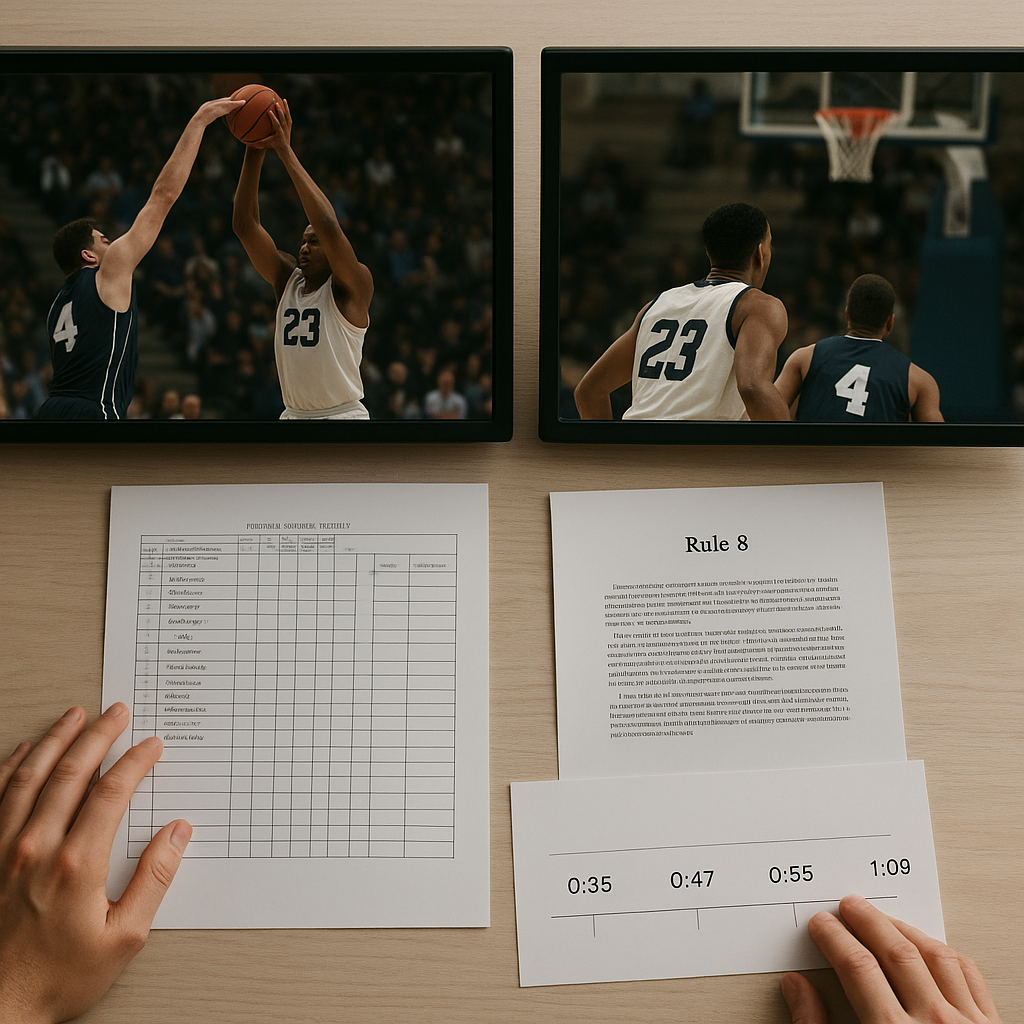
Time is central to the investigation. Official clocks, event logs, score records, referee signals and device timestamps can help establish the sequence, but each has limits. Clocks may not be synchronised, and a timestamp may mark a recording or system event rather than the exact moment an action occurred.
Investigators should therefore build a shared timeline rather than rely on a single clock. Each item should be labelled with its source, time basis and margin of uncertainty. If records conflict, the discrepancy needs to be investigated, not ignored in favour of the more convenient record.
The governing rule is essential, but it does not prove what happened. Investigators should identify the relevant wording, competition instructions and procedures in effect at the time. Even a clear factual record can be disputed if people interpret the rule differently.
Official records can provide structure. A score sheet, referee notation, system log or written decision may show what was recorded during the event. These records are useful, but not automatically conclusive. Investigators need to know who made each entry, when it was made and whether it records an observation, a report or a later correction.
Audio and communication logs may clarify instructions, acknowledgements or the timing of a decision. But a recording may be incomplete, unclear or unrelated to the disputed point. The absence of a captured statement does not prove it was never made, and an audible exchange does not settle its meaning on its own.
The chain of custody matters too. Keep the original files, identify copies and document any edits or transfers. This helps confirm that reviewers are examining the same material and reduces the risk of a separate dispute over a clip’s origin or alteration.
Scenario of a review
Consider a hypothetical round in which one side says a decisive action came before a signal, while the other says it came after. The footage is close, and each side points to a different detail. Rather than start by deciding who is right, investigators should define the sequence they need to establish.
Reviewers would collect full recordings from available angles, the official event record, relevant clock or system logs, and the rule governing the signal. They would preserve the original files, note their sources and align the recordings using identifiable events. If the clocks differ, they should record the offset rather than imply false precision.
Next, the team would separate observations from conclusions. Video may show a hand moving, a log may register a signal, and a witness may recall hearing an instruction. Deciding whether those events meet the rule is a separate judgement. The review should explain how each piece of evidence supports that judgement.
If the evidence cannot establish the sequence with confidence, reviewers should say so. A review is not more rigorous just because it gives a definite answer. It is more rigorous when it explains what can be established, what remains uncertain and why.
Conclusion
The easiest disputed rounds to investigate are not necessarily those with the most footage. They are the ones where evidence is preserved, independently checkable and tied to a clear question. Multiple angles, a careful timeline, contemporaneous records and the applicable rule each serve a different purpose.
Fairness means avoiding shortcuts: treating a replay as self-explanatory, accepting an official note without context or mistaking confidence for corroboration. A transparent review weighs sources consistently, acknowledges their limits and separates factual findings from interpretation. It may not end the disagreement, but it makes the basis for any decision easier to examine.