How to Research Comparable Sales Before Buying a Domain
Introduction
A domain purchase can seem straightforward until the seller names a price. A short, memorable address may look valuable, but instinct alone can’t establish its worth. You need to find out what similar domains have sold for and whether those sales are relevant. Domain sales research helps turn that evidence into a more grounded decision.
Start with evidence and narrow it down. The goal isn’t to find a past sale that supports the price you already want to pay. It’s to establish a credible range, understand the differences between domains and decide how much uncertainty you’re willing to accept. A disciplined domain sales research process keeps the focus on relevant facts rather than a preferred outcome.
Domain markets are thin and uneven. Two similar names can attract very different buyers, and a headline sale may reflect a private strategic need—not a price another buyer could expect to pay. That’s why domain sales research should consider the circumstances behind a sale, not just its reported figure.
Analysis of Buyers and Sellers
In a domain negotiation, each side has different information. The seller may know the domain’s history, previous offers and reasons for holding it. The buyer must assess the market without assuming the asking price reflects its true value. Domain sales research can help balance that information gap, though it can’t reveal every private detail.
Start with the domain itself. Note its extension, length, spelling, pronunciation, word order and meaning. Consider whether it’s a generic term, a brandable name or a phrase tied to a particular industry. These qualities affect a domain’s appeal, but they don’t determine its price on their own. In domain sales research, name quality is one factor to assess alongside evidence of demand.
Next, identify likely buyers. A term with a clear commercial use may appeal to companies in one category, while a catchy, broad name could suit several industries. Buyer research can help identify plausible users and the problem the domain might solve for them: improving recall, creating a stronger brand, signaling a category or protecting against a competitor. This context makes domain sales research more useful than a simple list of prices.
Demand can be limited even for a short domain if its meaning is awkward, its spelling is easy to confuse or its best use is confined to a small group of businesses. A larger pool of potential buyers doesn’t guarantee a sale, but it may support a higher price than a name that depends on one particular company. Domain sales research should account for this difference in potential demand.
Key Factors
Build your evidence around comparable sales, not superficial similarities. The principle of comparing like with like is central to the comparables approach to valuation. Domain research requires extra care, though, because every domain is unique and transaction details may be incomplete. Careful domain sales research applies this principle to the distinctive features of each name.
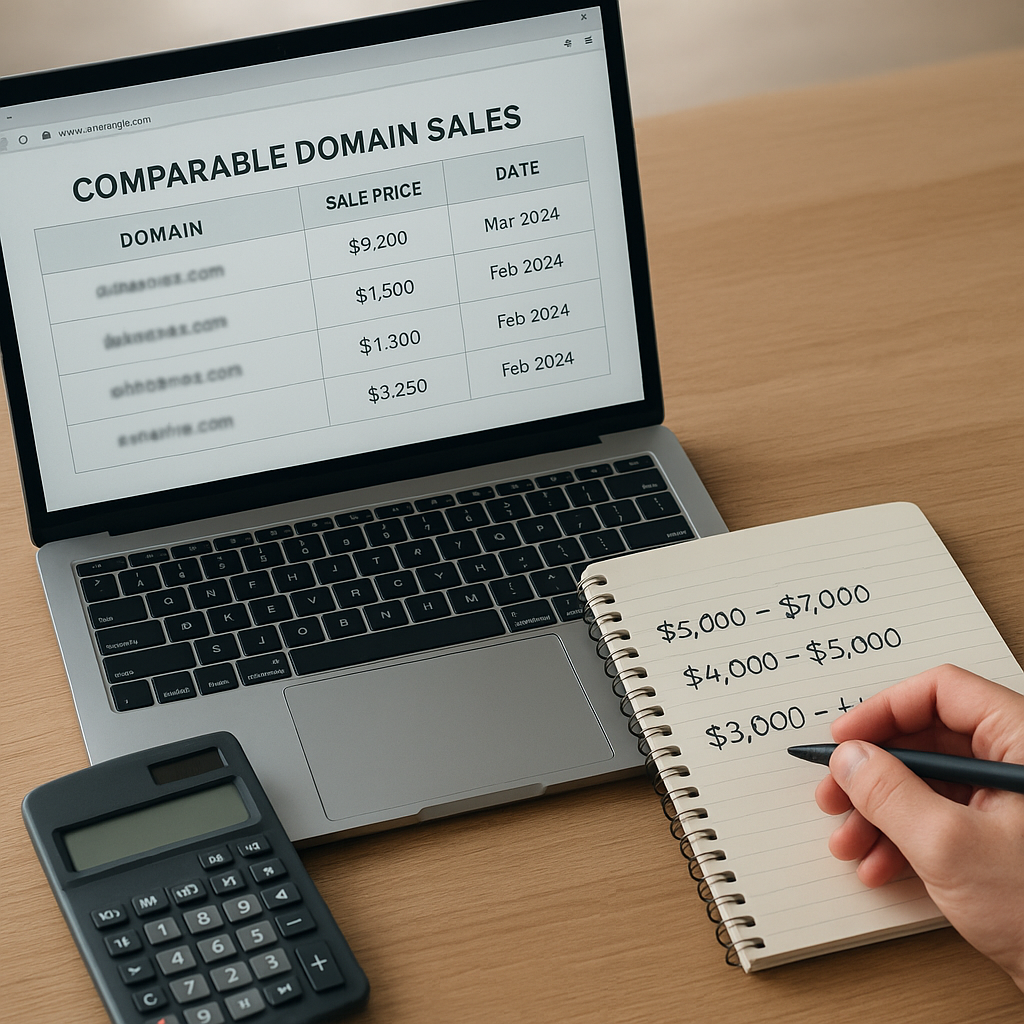
For each sale, record the reported price, date, extension, name structure and apparent commercial use. Give more weight to sales that share several meaningful features with the domain you’re considering than to a famous sale in the same broad category. For example, a two-word .com and a short country-code domain may attract different buyers, even if they contain the same keyword. This comparison is a core step in domain sales research.
Recent sales can reflect current buyer behavior, while older ones may reveal lasting demand for a word or naming pattern. Consider both, and don’t treat one transaction as a trend. Looking across multiple periods can make domain sales research less dependent on a single market moment.
Check the reliability of each data point. Public reports may not say whether a sale included other assets, whether the price came from an interested party or whether the transfer was completed. If details are unclear, mark the sale as uncertain rather than giving it the same weight as a well-documented transaction. Reliable records make domain sales research more persuasive.
Distinguish the domain’s qualities from the circumstances of its sale. An urgent seller, a private negotiation, a brokered auction or a buyer facing a deadline can all affect the price. These factors may explain a sale, but they don’t necessarily predict what a patient buyer would pay today.
Valuation tools can help you find sales, organize records and spot patterns, but their estimates aren’t proof of value. Treat them as a starting point: check their inputs, compare suggested sales with the domain you’re considering and discount results based on weak or mismatched evidence. Use these tools to support domain sales research, not to replace your own assessment.
Set a range rather than a single figure. A practical approach includes a conservative value supported by the closest sales, a central estimate based on the strongest group of evidence and a higher ceiling that would require unusually strong demand or strategic urgency. Domain sales research should inform the range while leaving room for uncertainty.
Also account for costs beyond the purchase price: renewals, transfer fees, escrow or brokerage expenses, and the opportunity cost of tying up your capital. Consider that it could take years to sell the domain—or that no buyer may offer the price you expect.
Match Scenario
Imagine a buyer considering a two-word domain that pairs a familiar industry term with a broad brand word. The seller points to a much higher sale of a shorter, single-word .com and argues that the domain deserves a similar premium. The buyer should assess whether the two domains share enough features and buyer demand for that comparison to hold. Domain sales research offers a way to test the seller’s comparison against closer evidence.
The buyer gathers several closer sales, checks their dates and extensions, and notes which names had clear commercial meaning. One sale is recent but poorly documented; another is older and structurally similar; a third includes a related website. Instead of averaging the prices, the buyer gives the clearest evidence the most weight and explains why the other sales count for less.
This gives the buyer a stronger basis for negotiation. They can separate the seller’s asking price from the evidence-supported range while recognizing that a particular company may see strategic value the wider market data can’t capture. A credible competing buyer could shift the balance. Without one, the buyer’s willingness to wait may strengthen their position.
Research can’t guarantee a win. A buyer may still lose the domain to someone with a stronger use for it, and a seller may reject a reasonable offer. The point is to understand the trade-offs before committing capital.
Conclusion
Comparable sales are evidence, not instructions. Their value depends on how closely they match the domain, how reliable the reported details are and whether the circumstances of each sale resemble the current decision.
Good research combines sales data with an assessment of the domain’s quality, buyer demand, costs and uncertainty. Domain sales research won’t produce a perfect number, but it can help you set a defensible price and decide what would need to be true for the purchase to make sense.